
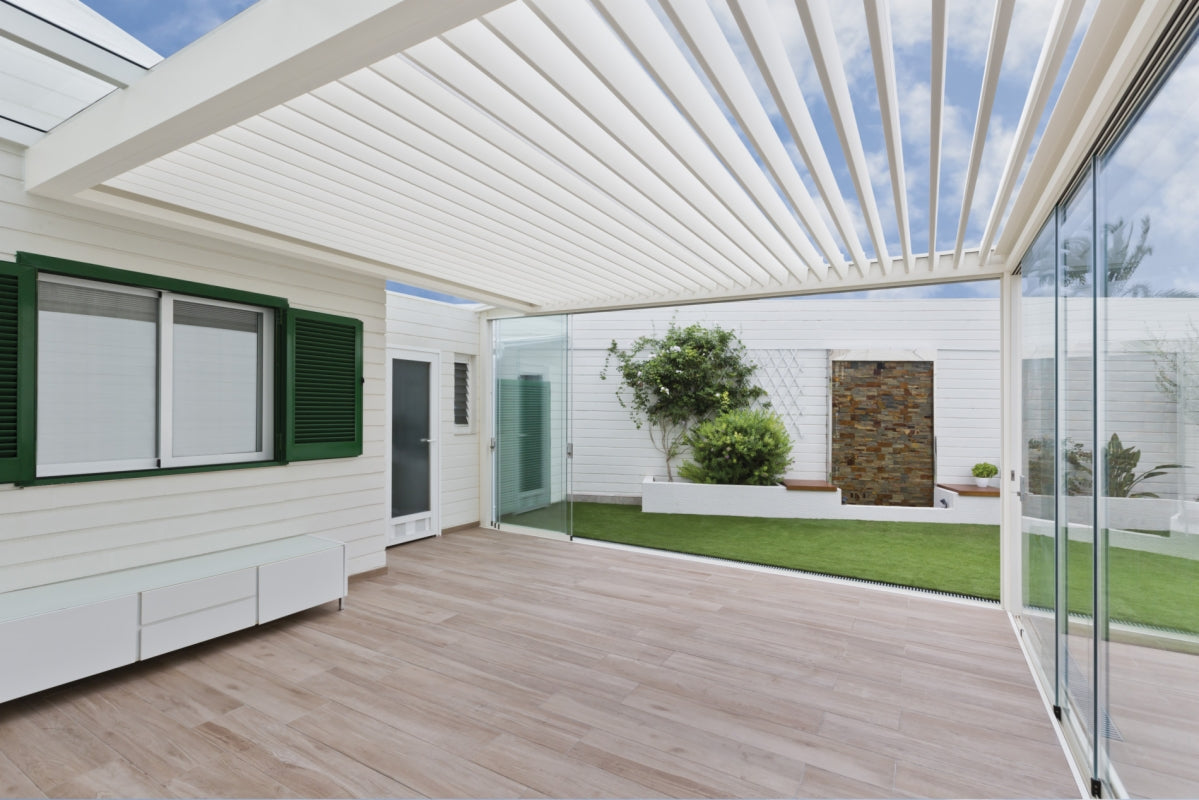
Pergola with louvered roof in Polop
A pergola with a louvered roof in Polop does not start with a color sample, but with the question of how you want to live outdoors. A pergola with a louvered roof provides an adjustable roof that regulates light and shade. Port of Altea provides advice, measuring, delivery, and professional installation from our showroom in La Nucía.
For newly built villas in exposed locations in Polop, sun, wind, rain, ground conditions, façade, and daily use must be assessed together. A pergola is a bespoke structural product. Dimensions alone therefore never tell the whole story.
What kind of outdoor space do you want to create?
A pergola can provide shade, visually connect a terrace to the home, and extend the outdoor season. The intended use determines the system: occasional summer shade requires something different from regularly dining outdoors in changeable weather. Sightlines, furniture, doors, and the route to the garden or pool also matter.
We discuss when the sun reaches the terrace, which side catches the wind, and how much openness you want to retain. We then choose the roof type, dimensions, and options. This way, the pergola becomes not a standalone object, but an outdoor space that works logically.
Louvered roof, fabric roof, or retractable roof
Aluminium louvers can tilt to regulate light and ventilation and close to channel rainwater away. A fabric roof has a softer appearance and can open compactly, but requires different consideration regarding wind, tension, and wet fabric. A retractable solution offers great flexibility when you also want completely open skies.
No roof type is automatically the best. Span, orientation, desired rain protection, maintenance, and appearance determine what is suitable. We explain not only the benefits, but also the limitations of each system. This prevents an attractive sales promise from becoming an expensive annoyance later.
Measuring and structural preparation
We check the width, projection, and height at multiple points, as well as the façade, roof edge, windows, doors, downpipes, and installations. For a freestanding pergola, we assess the post positions and the load-bearing capacity of the ground. Existing tiles are not automatically a suitable foundation.
The structural fixing must suit the dimensions, model, and location. If additional calculations, reinforcement, or a foundation are required, this must be clear before ordering. We do not guess about anchors just because a terrace happens to be beautifully tiled.
Wind on the Costa Blanca
An exposed location, changes in elevation, and sea winds can significantly increase the load. Wind resistance is never just a figure in a brochure: dimensions, the installation surface, closed screens, and correct use all affect the overall system. Sensors can help, but they do not replace responsibility for safe use.
In strong winds, fabric roofs and screens must be opened or retracted in accordance with the instructions. Louvers also have a prescribed position. We explain the correct operation at handover, so that comfort does not come at the expense of service life or safety.
Rain and controlled water drainage
Many pergolas drain water through gutters and hollow posts. For this to work, the slopes, connections, and outlet points must be correct. We determine in advance where water can flow without ending up by a door, pool steps, or a neighbour’s terrace.
A terrace cover is not the same as a completely watertight indoor space. Wind-driven rain can enter depending on the wind and the chosen side closures. Condensation and splashing water also require attention. We make clear what level of protection is realistic.
Screens, glass, and other side closures
Integrated screens reduce low-angle sunlight and light wind, but change the wind load when closed. They must therefore be designed as part of the system. Glass sliding walls provide transparent shelter and require space for rails, panels, and water drainage.
By taking options into account in advance, profiles, cables, and connections remain neatly integrated. Adding them later is sometimes possible, but not every basic model is prepared for every extension. Also view our complete cluster about glass sliding walls and terrace glazing.
Lighting, heating, and controls
Integrated LED lighting creates ambience without separate fixtures. Terrace heating requires sufficient clearance, suitable power, and a safe electrical connection. Cable routes, power supplies, and controls are therefore planned before the profiles are produced or installed.
Remote controls, wall transmitters, apps, and sensors can work together in groups. Smart control is especially convenient when it remains simple. We agree which button operates which component and do not provide a cockpit that requires a pilot’s licence first.
Permits and homeowners’ associations
Rules vary by municipality, development, and building. A pergola may require permission or notification, especially in the case of fixed structures, visible façade alterations, or apartments. The owner remains responsible for obtaining the necessary permission; we can provide technical product information for discussions with an architect, property manager, or municipality.
Do not order until it is clear what is permitted at the location. A neighbour’s verbal approval is not a permit, and a similar pergola elsewhere does not prove that your situation is the same.
What determines the price?
The price is determined by the width, projection, roof type, profile colour, motorisation, lighting, screens, glass, accessibility, foundation, and installation. A straight façade with prepared power and drainage is different from a sloping plot or a roof terrace requiring lifting equipment.
A good quotation specifies the construction, dimensions, options, installation, and necessary preparation. This allows you to compare complete solutions rather than basic starting prices. After measuring, you will receive a proposal tailored to the actual situation.
Maintenance in the coastal climate
Salt, sand, leaves, and insects accumulate in gutters, rails, and moving parts. Regular, careful cleaning with clean water and a mild detergent helps. Do not use abrasive products or random spray lubricants; follow the maintenance advice for the specific system.
Check drainage outlets, fixings, and movement after exceptional weather. Never force a motor when something is blocked. Early attention to noise, misalignment, or leaks often prevents more serious damage.
From design to handover
- We discuss function, appearance, sun, and wind.
- We measure the façade, ground, height, and obstacles.
- We choose the roof, colour, options, and controls.
- You receive a complete quotation for bespoke work and installation.
- After production, we install, adjust, and test the system and explain its use and maintenance.
Advice from Port of Altea
Would you like to know which pergola suits your terrace? View the main page about pergolas and terrace covers, visit our showroom in La Nucía, or contact us.
La Nucía showroom
Come and see, feel and compare.
Bring photographs, approximate measurements or a floor plan to our La Nucía showroom. You can also discuss a home consultation or video call with us.
Tue–Fri 09:30–17:00 · Sat 09:30–14:00