
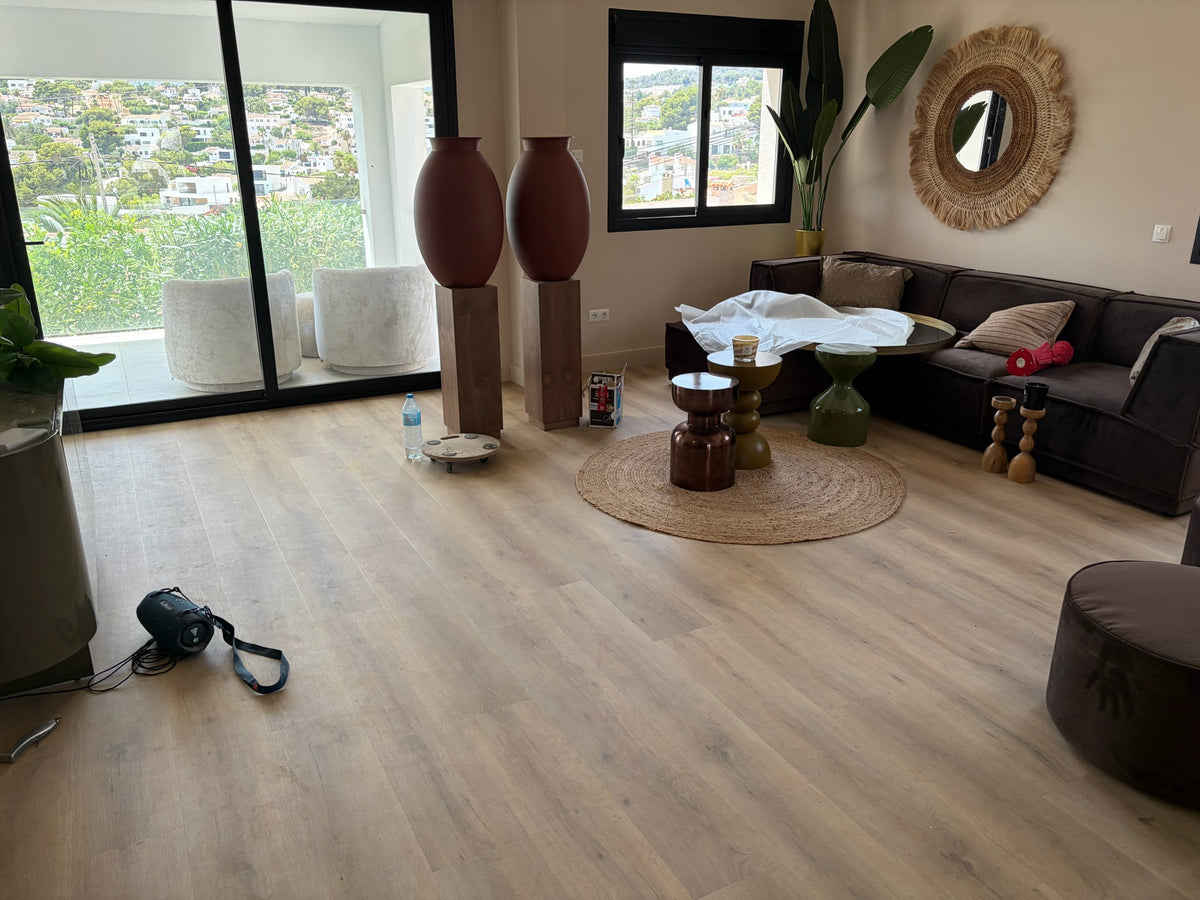
Renovating a floor without extensive demolition work in Spain
Renovating a floor without extensive demolition work in Spain is about the options for installing over existing tiles and the realistic limits of renovation. Port of Altea helps occupied homes and apartments where dust, demolition work and downtime need to be kept to a minimum, with a flooring plan that is both technically and visually sound. We supply high-quality collections through Dutch suppliers and provide advice, measuring, delivery and professional installation on the Costa Blanca.
In Spain, people often make a quick choice based on a colour sample or a separate per-square-metre price. We look further: at the existing tiled floor or screed, exposure to sunlight, temperature, doors, skirting boards, acoustics and everyday use. This helps prevent an attractive material from later proving unsuitable for the room or subfloor.
Why choose to renovate a floor without extensive demolition work in Spain?
The best floor does not exist separately from the home. LVT performs strongly in terms of maintenance and design freedom, vinyl in terms of comfort and versatility, and carpet in terms of softness and acoustics. Comparing these properties with actual use leads to a choice that remains suitable for longer than a trend colour.
For occupied homes and apartments where dust, demolition work and downtime need to be kept to a minimum, it is especially important to balance appearance with practical properties. That is why we compare samples in suitable light and discuss in advance which expectations are realistic regarding wear, cleaning, heat and sound.
Quality from Dutch collections
Our floors are brought to Spain through Dutch suppliers. This provides access to a broad and up-to-date range, clear product information and qualities that are not always available in the standard local assortment. We select not only by brand name or sales pitch, but by suitability for your project.
In our showroom in La Nucía, you can view materials side by side. This is important because surface texture, sheen, pile and colour react differently in bright daylight than on a screen. Bring photos and approximate measurements so that we can make a focused selection.
Subfloor and technical preparation
As part of a comprehensive flooring assessment, we check load-bearing capacity, flatness, moisture, existing finishes, underfloor heating and the desired build-up height. Skirting boards, stairs and transitions are also considered in advance, so the proposal does not become a collection of separate items.
We also check whether existing tiles are securely fixed, whether joints need to be levelled and whether there are signs of moisture or cracking. Doors, kitchen plinths, sliding doors and transitions can determine the maximum possible build-up height.
Suitable for living on the Costa Blanca
Large glass surfaces, direct sunlight and homes that sometimes remain closed for weeks require attention. Ventilation, air conditioning and solar shading affect the indoor climate; flooring materials must be stored and installed according to the technical specifications. In apartments, we also consider impact sound and the rules of the comunidad.
For a holiday home, easy maintenance may be especially important, while softness and quietness may matter more in a bedroom. In a permanently occupied villa, continuous sightlines and connections to the kitchen and stairs often take centre stage. The same product is therefore not automatically the best choice for every room.
Colour, direction and finish
Visual calm is determined by colour, plank or strip direction, pattern, joint appearance and the connection to doors. Large samples are important: a design that looks calm in A4 format can appear much busier across sixty square metres.
We recommend viewing material samples together with wall colour, kitchen fronts and curtains. Cool grey can appear harsher in Spanish sunlight, while warm oak tones may look more yellow. A calm mid-tone is often more forgiving of sand and everyday use than an extremely light or dark colour.
Maintenance and lifespan
Maintenance starts with a suitable entrance mat zone, felt pads or suitable glides, and cleaning appropriate for the material. Aggressive universal products can damage a protective layer or finish; more soap rarely means a cleaner floor.
At handover, ask which cleaner and protection are suitable for the chosen floor. Maintenance advice should be specific: how often to clean, how much product to use and what to do in the event of stains or damage. This prevents well-intentioned but harmful cleaning experiments.
What determines the price?
The price consists of more than the material. Surface area, cutting waste, pattern, preparation, adhesive or underlay, skirting boards, profiles, transport and accessibility all count. A straight, empty room is planned differently from an occupied apartment with many doors and fixed furniture.
After measuring, we can provide a clear cost breakdown. This shows you which works are included and which situations may count as additional work. This is more reliable than a vague starting price that says nothing about the condition of your home.
How a project with Port of Altea works
- Compare samples and discuss your requirements in our showroom in La Nucía.
- Have the rooms and existing subfloor professionally assessed.
- Receive a proposal for materials, preparation and finishing.
- Coordinate delivery and installation with access and other work.
- After installation, check the floor, skirting boards, transitions and maintenance instructions.
Personal advice
Would you like to know whether renovating a floor without extensive demolition work in Spain is suitable for your home? Contact Port of Altea or visit our showroom in La Nucía. Also view our complete overview of flooring on the Costa Blanca.
Details that are often underestimated when renovating a floor without extensive demolition work in Spain
Pay particular attention to the interaction between material, subfloor and finish. In a quotation, these details are less noticeable than the name of a collection, but during everyday use they determine whether the result truly performs. Therefore, ask for an explanation of every layer and finish being proposed.
In addition, a technically sound floor can still look unbalanced if direction, skirting boards and transitions have not been determined in advance. When products can be installed in different ways, the supplier should explain why one option is preferable in your home. A choice without justification is not advice but a gamble with a nice sample attached.
Assessing everything before the final order
A practical check is simple: view the plan from adjoining rooms; interruptions and unusual starting lines are easiest to spot there. Combine this with photos of the room, the direction in which doors open and information about underfloor heating or intense sunlight. This brings aesthetic and technical decisions together.
Finally, record who will move the furniture, how the subfloor will be left, where materials can be stored temporarily and when the room may be used again. Good planning prevents damage and rushed work during the final stages.
A complete handover
After installation, check not only the main surface but also edges, skirting boards, profiles, seams and connections. Ask what maintenance is permitted from day one. Port of Altea remains involved throughout the process, from the initial material selection to the practical explanation after handover.
More about flooring on the Costa Blanca
Also view this information about material selection, preparation and professional installation:
La Nucía showroom
Come and see, feel and compare.
Bring photographs, approximate measurements or a floor plan to our La Nucía showroom. You can also discuss a home consultation or video call with us.
Tue–Fri 09:30–17:00 · Sat 09:30–14:00